Why is a Korean Entry Visa Important?
Any foreigner entering South Korea must obtain a visa that matches their purpose of stay. A visa is the most fundamental document proving the legality of your stay in Korea, and the scope of your activities and duration of stay will vary depending on which visa you receive. Just as a passport is essential for international travel, a visa tailored to your purpose is mandatory for entering Korea.
Understanding Visas Makes Life in Korea Easier
The word “visa” can feel daunting and complicated. However, if you accurately identify and prepare the visa information that fits your situation, entering and living in Korea becomes much smoother. This guide organizes various visa-related information in an easy-to-understand way to help you execute your plans in Korea successfully.
Types of Korean Entry Visas: Which One is Right for You?
Korean visas are diverse and can be broadly categorized into short-term and long-term stays.
1. Short-Term Visas (C-Series)
Generally issued for temporary stays of up to 90 days.
- C-1 (News Reporting): For news coverage, broadcasting, or advertising activities.
- C-2 (Short-term Business): For non-profit commercial activities like market research or contract signing.
- C-3 (Short-term Visit): The most common visa for tourism, visiting relatives, medical treatment, or short-term training. Sub-types include C-3-1 (General), C-3-3 (Medical), etc.
- C-4 (Short-term Employee): For short-term employment in manual labor, entertainment, arts, or sports.
2. Long-Term Visas (D, F, E, H Series, etc.)
Issued for stays exceeding 90 days for specific activities.
- D-Series (Study and Training):
- D-2 (Study): For students enrolled in undergraduate or graduate programs.
- D-4 (General Training): For Korean language training or research-related courses.
- D-10 (Job Seeking): For those looking for employment in Korea.
- F-Series (Family and Long-term Residency):
- F-1 (Visit & Stay): For staying with family members who are already in Korea.
- F-2 (Resident): For those meeting specific long-term residency requirements.
- F-4 (Overseas Korean): For ethnic Koreans (e.g., from China, USA) to work and stay freely.
- F-6 (Marriage Immigrant): For those married to a Korean citizen.
- E-Series (Professional Employment):
- E-2 (Foreign Language Teaching): For teaching conversation at schools or academies.
- E-7 (Foreign National of Particular Ability): For professional work utilizing specialized knowledge. (One of the most common work visas).
- Other Visas:
- H-1 (Working Holiday): Allows youth from certain countries to combine travel with part-time work.
Step-by-Step Visa Application Procedure
The process may vary by nationality and location, but generally follows these steps:
Step 1: Determine Visa Type and Check Eligibility Identify the visa that matches your purpose. Each has different requirements (education, career, income, etc.).
- Tip: Check the Korea Visa Portal (https://www.visa.go.kr) or your local Korean Embassy website.
Step 2: Prepare Required Documents Commonly required documents include:
- Passport (valid for at least 6 months)
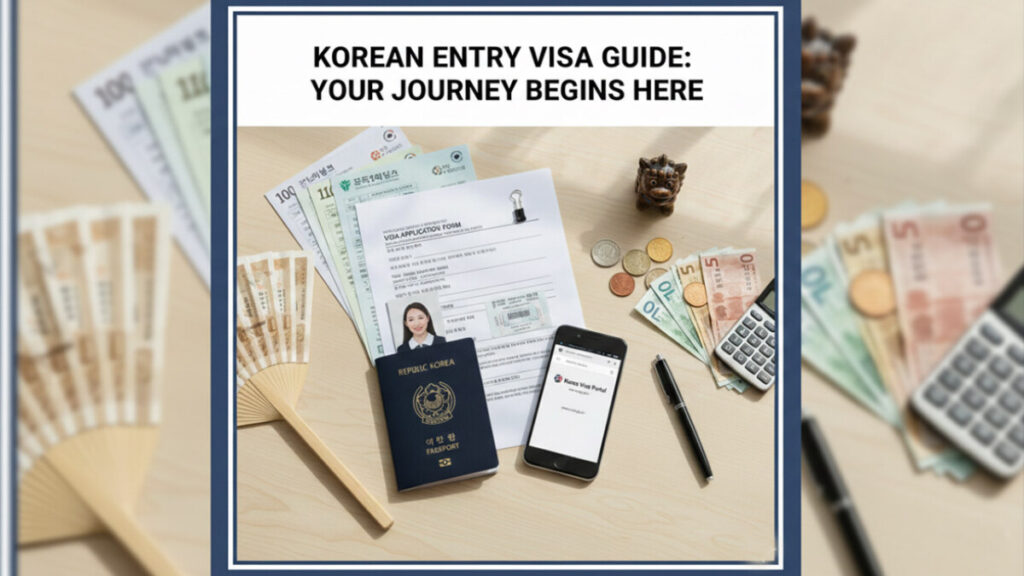
- Visa Application Form
- Passport-sized Photo
- Fee
- Category-specific documents: Certificate of Admission (D-2), Employment Contract (E-7), Marriage Certificate (F-6), or Job Seeking Plan (D-10).
- Note: Documents in foreign languages may require translation and notarization (Apostille).
Step 3: Submit the Application Usually done through the Korean Embassy or Consulate in your country of residence.
- Overseas: Make an appointment, submit documents, and undergo an interview if required.
- Online: Some visas (like tourist visas) can be applied for via the Korea Visa Portal.
Step 4: Screening and Notification Screening can take anywhere from a few weeks to several months depending on the visa type. You will be notified via email or the portal.
Step 5: Issuance and Entry Once approved, you will receive a visa sticker in your passport or a “Visa Grant Notice” printout. Carry this plus your supporting documents (Admission letter, contract) when entering Korea.
Frequently Asked Questions (FAQ)
- Q: Can I apply for a visa after arriving in Korea?
- A: Generally, no. You must apply before entry. Only very limited cases allow for a change of status after arriving.
- Q: Is an interview mandatory?
- A: It depends. Visas like the F-6 (Marriage) or certain employment visas often require an interview to verify authenticity.
- Q: How much financial proof is required?
- A: This varies. For D-2 or D-10 visas, you typically need to prove you have enough funds to cover tuition and living expenses for a set period.
Tips for a Successful Application
- Check Latest Info: Regulations change frequently. Always refer to official government sites.
- Be Thorough: Incomplete documentation is the leading cause of visa rejection.
- Be Honest: Providing false information can lead to severe penalties or permanent bans.
- Allow Enough Time: Start the process well in advance of your planned departure date.
Conclusion
While visa processes may seem complex, preparing systematically according to your situation makes it manageable. We hope this guide helps you start your new journey in South Korea successfully.
EXTERNAL_LINKS: Ministry of Justice’s Immigration and Foreign Policy Headquarters, Korea Visa Portal