
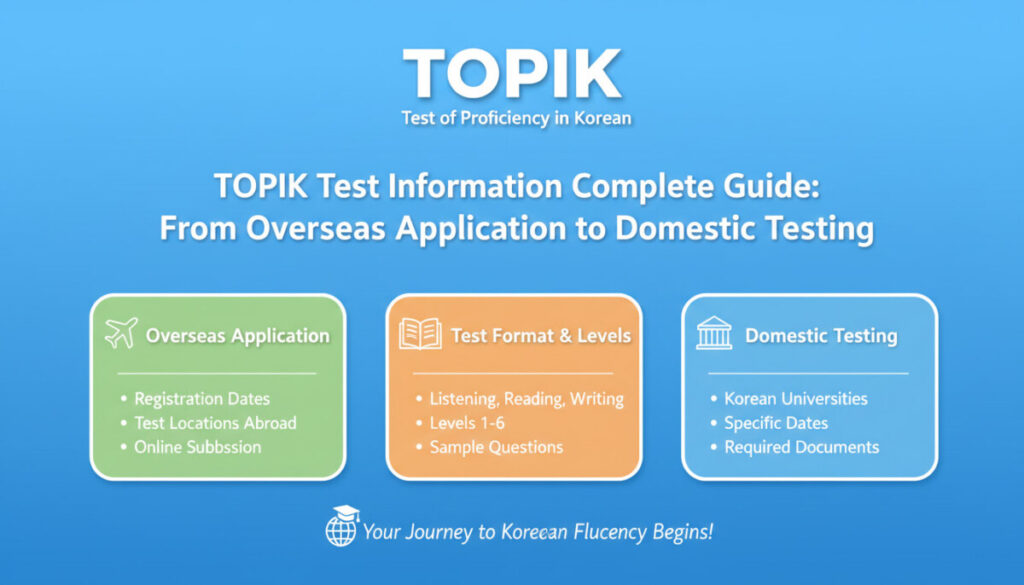
TOPIK Test: Why Is It Important?
TOPIK (Test of Proficiency in Korean) is a test that measures and evaluates the Korean language ability of foreigners and overseas Koreans who do not use Korean as their native language. It’s used to prove Korean proficiency for various purposes such as studying at Korean universities, employment, and admission to Korean language education institutions. Especially for those who want to study or work in Korea, TOPIK scores are essential.
TOPIK Test Types and Levels
The TOPIK test is largely divided into two types: TOPIK I and TOPIK II.
- TOPIK I: Consists only of reading and listening sections, evaluating levels 1 and 2. Targets beginner learners.
- TOPIK II: Consists of listening, writing, and reading sections, evaluating levels 3 to 6. Targets intermediate and advanced learners.
Since the required Korean proficiency level differs for each level, it’s important to choose a test that matches your learning goals and current ability.
Uses of TOPIK Test
TOPIK scores are used in various fields as follows:
- University Admission: Many cases require TOPIK scores as a requirement for admission to Korean graduate schools or universities.
- Employment: Can be used as documentation to prove Korean ability when getting a job at Korean companies or working in Korea-related positions.
- Visa Issuance: Some employment visas or residence visas may require TOPIK scores.
- Government Scholarship Support: TOPIK scores may be needed when applying for various government scholarship programs provided by the Korean government.
- Korean Ability Improvement: Helps objectively evaluate your Korean proficiency and provide learning motivation.
How to Take TOPIK Test Overseas
Here’s a detailed guide for those who reside overseas or want to take the TOPIK test abroad.
1. Overseas TOPIK Test Registration Procedure
Check TOPIK Official Website: First, access the TOPIK official website (https://www.topik.go.kr/) to check announcements related to overseas testing. You can get the latest information on test schedules, registration periods, test fees, and test regions.
Check Overseas Test Regions and Registration Offices: TOPIK tests are conducted in many countries worldwide. Check on the official website whether tests are conducted in your country or nearby countries, and identify the registration office in that region (in major countries, Korean embassies or cultural centers).
Online Registration: Most overseas TOPIK tests register online. After signing up as a member on the designated registration website of that country or through the TOPIK official website, proceed by entering test information and paying the test fee.
Submit Supporting Documents (if necessary): Some countries may require submission of additional documents such as ID copies. Carefully check the instructions provided during registration and prepare.
Print Admission Ticket: Once registration is complete, you can print your admission ticket. Be sure to bring it on test day, so prepare it in advance.
2. Precautions When Taking Overseas TOPIK Test
Check Test Schedule: Overseas tests are often held only 1-2 times a year, so you must check the test schedule in advance and be careful not to miss it.
Observe Registration Period: Registration periods can be very short, so you must complete registration within the period.
Select Test Region: You should select the country where you reside or a country that’s easily accessible.
Check Test Fee: Test fees may differ by country, so check the exact amount during registration.
Test Environment: Overseas tests may have some differences in test environment or supervisor operation methods compared to domestic tests.
Score Announcement: It’s good to check the score announcement date and score report collection method in advance.
3. Overseas Test Preparation Tips
Obtain Accurate Information: Regularly check the Korean embassy or cultural center website in your country of residence to not miss TOPIK test-related announcements.
Pre-visit Test Location: If possible, visit the test location in advance to identify the location and transportation, so you won’t panic on the day and can focus on the test.
Use Local Korean Learning Community: Exchanging information with people preparing for TOPIK tests locally can provide useful tips.
How to Take TOPIK Test in Korea
Here’s a guide for those residing in Korea or planning to take the TOPIK test in Korea.
1. Korea TOPIK Test Registration Procedure
Access TOPIK Official Website: Access https://www.topik.go.kr/
Sign Up: Membership registration is required for TOPIK test registration.
Apply for Test: In the ‘Test Application’ menu, select the desired test (TOPIK I or TOPIK II), and choose the test session and region (within Korea).
Enter Personal Information: Accurately enter your information such as name, date of birth, and nationality.
Upload Photo: You must upload an ID photo that allows identification according to specifications. (Refer to photo specification guide during test registration)
Pay Test Fee: Pay the test fee through various methods such as credit card or bank transfer.
Print Admission Ticket: After registration is complete, you can print your admission ticket from My Page. You must bring it to the test center.
2. Precautions When Registering for Korea TOPIK Test
Check Test Schedule: TOPIK tests are held 6 times a year (mainly in March, April, May, July, August, October). Exact test schedules must be checked on the TOPIK website.
Registration Period: Registration periods are usually given for about a week starting approximately 4 weeks before the test date. Be careful not to miss this period.
Select Test Center: You can select a test center in your residential area or a region with good accessibility. Popular test centers may close early, so it’s good to apply quickly.
Photo Specifications: The uploaded photo must be identifiable and if it doesn’t meet specifications, registration may be rejected.
Refund Policy: Check cancellation and refund policies in advance to avoid disadvantages.
3. Korea Test Environment
Test Centers: In Korea, tests are conducted at universities and educational institutions nationwide.
Test Time: TOPIK I and TOPIK II test times differ. You must accurately check your test time on the test day.
Required Items: You must bring your admission ticket, ID (resident registration card, driver’s license, passport, etc.), and writing instruments (black pen, pencil, eraser).
How Should You Prepare for TOPIK Test?
Consistent learning and strategic approach are important for the TOPIK test.
1. Set Learning Goals and Establish Plans
Set Target Level: Clearly set the TOPIK level you’re targeting. The required level differs depending on specific goals such as university admission or employment.
Learning Plan: Establish a specific learning plan to achieve the target level. Decide how much time to invest daily and which areas to focus on.
Time Management: It’s important to create a realistic plan considering the time remaining until the test date.
2. Learning Strategies by Area
Listening: Consistently listen to various Korean audio materials (dramas, variety shows, news, podcasts, etc.) and become familiar with question types by repeatedly solving listening sections of past TOPIK papers. Dictation practice is also effective.
Reading: Improving vocabulary and grammar skills is essential. Build reading comprehension by reading texts on various topics, and increase problem-solving speed by solving reading sections of past TOPIK papers. Always organize and memorize unknown words.
Writing (TOPIK II): Sentence composition ability and logical writing ability are important. Analyze past TOPIK writing papers and practice writing directly on various topics. Getting reviews and feedback on your writing is very helpful. It’s especially good to learn strategies by question type for numbers 51, 52, and 53.
3. Importance of Using Past Papers
Past papers are the best learning materials for the TOPIK test.
Obtain Latest Past Papers: Use past papers provided on the TOPIK official website or past paper collections published by educational evaluation institutions.
Solve Like the Real Test: Solve problems while timing yourself the same as actual test time.
Analyze Wrong Answers: Always analyze why you got questions wrong and re-learn related content.
Repeated Learning: Repeatedly solve past papers multiple times to increase understanding of question types and reduce mistakes.
4. Vocabulary and Grammar Learning
Use TOPIK Designated Vocabulary: Consistently memorize using TOPIK level-specific designated vocabulary lists.
Learn in Context: Rather than memorizing words alone, it’s important to understand how they’re used in sentences.
Solidify Basic Grammar: You must clearly understand and master basic grammar frequently tested in TOPIK exams.
5. Use Study Groups or Academies
Study Groups: You can share information with people studying together and provide motivation to each other.
Academies/Online Lectures: You can learn efficiently through systematic curricula and professional guidance. Especially for the writing section, expert corrections are very helpful.
TOPIK Test Related Frequently Asked Questions (FAQ)
Q1. When do TOPIK test results come out? A1. You can check them on the TOPIK official website about 2-3 weeks after the test ends. Score reports can be printed online or received by mail.
Q2. Are there eligibility restrictions for taking the TOPIK test? A2. Anyone who is a foreigner or overseas Korean excluding Korean nationality can take it.
Q3. What are the TOPIK test passing criteria? A3. The total score and minimum score by section that must be obtained differ for each level. You can check detailed passing criteria on the TOPIK official website. (e.g., TOPIK II level 3 is 120 points or more total)
Q4. What is the validity period of TOPIK test results? A4. The validity period of TOPIK test results is generally 2 years from the score announcement date.
Conclusion
The TOPIK test is an important gateway for studying and working in Korea. Whether preparing for the test overseas or domestically, thorough information gathering and consistent learning are essential.
- Check Accurate Information: Check the latest information on test schedules, registration methods, and test regions through the TOPIK official website.
- Set Goals and Plan: Set your target level and establish an efficient learning plan by identifying strengths and weaknesses by area.
- Use Past Papers: Repeatedly solve past papers to develop a sense of the real test, and supplement weaknesses through error analysis.
If these efforts accumulate, you will definitely get good results. We support your successful TOPIK test preparation!
INTERNAL_LINKS: Learning Korean for Foreigners
EXTERNAL_LINKS: Topik official website, The National Institute of International Education, Korean University Admissions Information