KTX and SRT: What’s the Difference? High-Speed Train Selection Guide
When planning a trip, one of the first concerns that comes to mind is choosing the means of transportation. Especially for long-distance travel, fast and convenient high-speed trains are the choice of many people. Korea’s two representative high-speed trains, KTX and SRT, seem similar but differ in many ways. To help those who are hesitating about which train to choose, we will compare and analyze everything about KTX and SRT to assist in your wise decision.
1. KTX: The Symbol of Korea’s High-Speed Railway
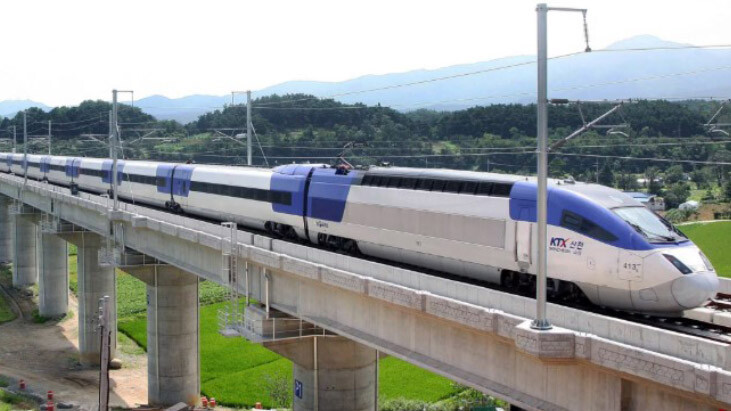
KTX (Korea Train eXpress) is Korea’s high-speed railway service operated by Korail (Korea Railroad Corporation). Since its opening in 2004, it has connected major cities nationwide and brought innovation to Korea’s transportation system.
1.1. KTX Operating Routes
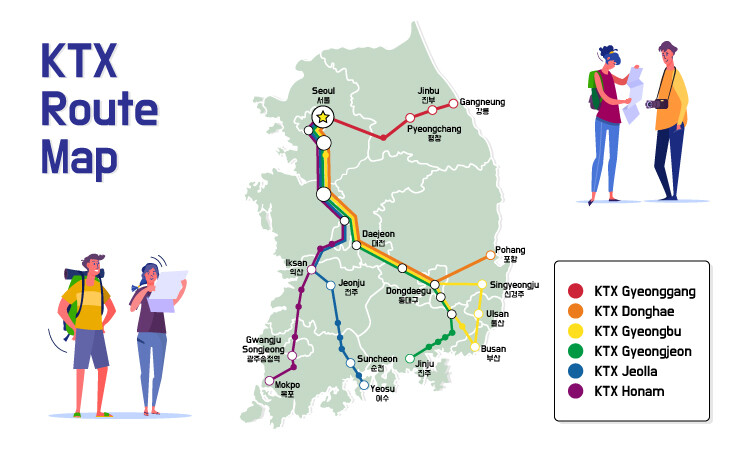
KTX boasts the widest operating range based on its nationwide railway network.
- Main Routes: It connects all major hubs nationwide, including Gyeongbu Line (Seoul-Busan), Honam Line (Yongsan-Mokpo), Gyeongjeon Line (Seoul-Jinju), Jeolla Line (Yongsan-Yeosu), and Donghae Line (Seoul-Gangneung).
- Various Branch Lines: Through the existing line high-speed project, KTX also operates on conventional line sections, further improving accessibility.
1.2. KTX Fare System and Discount Benefits
KTX operates various discount programs in addition to set basic fares.
- Basic Fare: Varies by section, and there may be slight differences depending on train type (KTX-I, KTX-Sancheon, etc.)
- Discount Benefits:
- Early Booking Discount: The earlier you book, the higher the discount rate you can receive (usually 10-40% off)
- Weekend/Holiday Discount: Sometimes offers discount benefits for specific time slots or seats
- Youth, Senior, Disability Discount: Applies a certain percentage discount to eligible individuals
- KORAIL Membership Benefits: Receive additional discounts or point accumulation benefits according to membership level
- Naeillo Ticket: A free travel pass for young people aged 25 and under, allowing unlimited use of trains including KTX for a certain period
1.3. KTX Amenities and Services
KTX provides various amenities and services to enhance the comfort of long-distance travel.
- Seats: Divided into standard class and first class, with first class offering wider seat spacing and more comfortable seats. All seats have power outlets for convenient use of electronic devices.
- In-Train Amenities:
- Restrooms: Clean and modern restrooms are provided
- Nursing Room/Accessible Restrooms: Some trains have separate spaces for family passengers or transportation-disadvantaged individuals
- Vending Machines/Beverage Stands: Vending machines where you can purchase simple beverages and snacks
- Bicycle Racks: Some trains have spaces where you can bring bicycles
- Services:
- Attendant Service: Provides passenger guidance and assistance
- In-Train Announcements: Kindly announces station arrival information, transfer information, etc.
1.4. KTX Advantages
- Extensive Operating Network: Excellent accessibility by connecting almost all major cities nationwide
- Various Discount Benefits: Cost savings possible through various discounts such as early booking and membership benefits
- Stable Operation: Has a stable operating system as it has been in operation for a long time
1.5. KTX Disadvantages
- Congestion on Some Routes: Seat availability may be difficult on major routes or during certain time periods
- Higher Fares Compared to SRT: Fares are often somewhat higher than SRT when comparing the same route
2. SRT: The High-Speed Train That Brought New Change
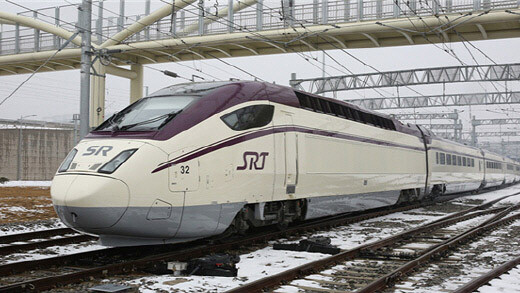
SRT (Super Rapid Train) is Korea’s high-speed railway service operated by SR. Opened in 2016, it competes with KTX while providing reasonable fares and convenient services.
2.1. SRT Operating Routes
SRT is concentrated on routes connecting the metropolitan area and southern regions.
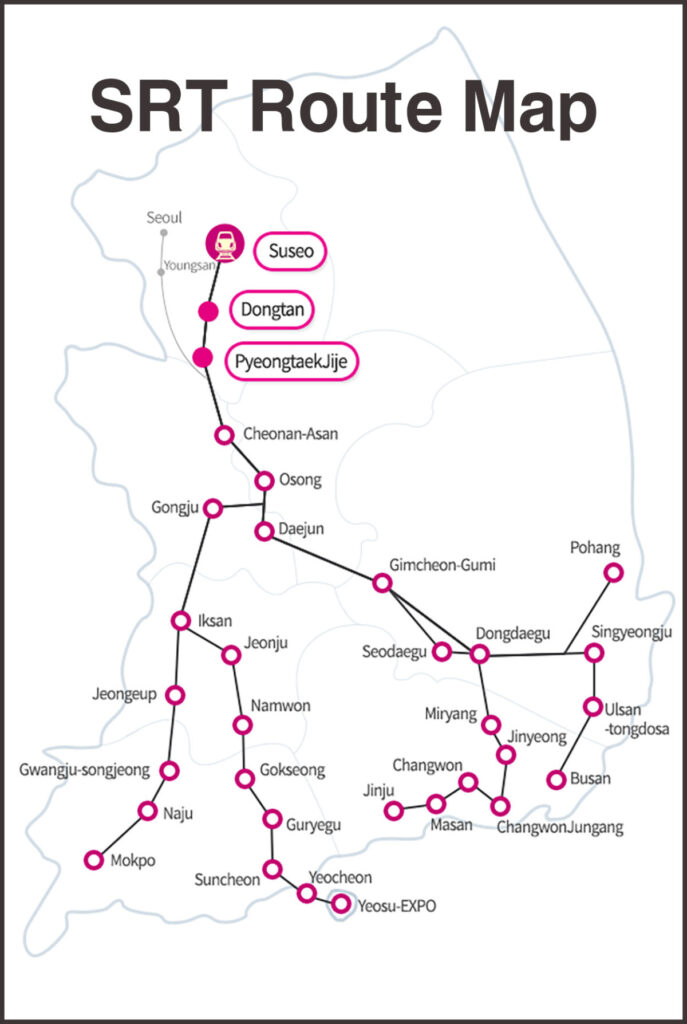
- Main Routes: Operates Gyeongbu High-Speed Line (Suseo-Busan) and Honam High-Speed Line (Suseo-Mokpo/Gwangju)
- Starting Point: Departs from Suseo Station in Seoul’s Gangnam area (Suseo Station is connected to Subway Line 3 and Bundang Line, offering good accessibility)
- Intermediate Stops: Passes through major cities including Dongtan, Jije, Cheonan-Asan, Daejeon, Gimcheon (Gumi), Daegu, Singyeongju, Ulsan, Busan, Iksan, Jeongeup, Gwangju-Songjeong, Naju, and Mokpo
2.2. SRT Fare System and Discount Benefits
SRT emphasizes reasonable fares compared to KTX and also provides various discount benefits.
- Basic Fare: About 10% cheaper when comparing the same route as KTX
- Discount Benefits:
- Special Price Products: Can use ‘SRT Special Price’ products to book in advance or use at discounted rates during specific periods
- Member Discount: Provides a certain percentage discount upon SRT membership registration
- Weekend/Holiday Discount: Sometimes offers discount benefits for specific time slots or seats
- Child, Senior, Disability Discount: Applies a certain percentage discount to eligible individuals
2.3. SRT Amenities and Services
SRT has facilities and services that prioritize passenger convenience.
- Seats: Divided into standard class and first class, providing a similar level of comfort as KTX. All seats have power outlets.
- In-Train Amenities:
- Restrooms: Clean and modern restrooms are provided
- Infant Nursing Room: Nursing rooms for family passengers are provided
- Cafe/Snack Bar: Space where you can purchase simple beverages and snacks on the train (tends to be larger than KTX)
- Luggage Storage Space: Some trains have separate spaces where you can store large luggage
- Services:
- Customer Announcements: Provides friendly and clear announcements
- Wi-Fi: Provides free Wi-Fi service on the train
2.4. SRT Advantages
- Reasonable Fares: Economical travel possible with cheaper fares compared to KTX
- Gangnam Area Accessibility: Convenient for Seoul Gangnam and southeastern metropolitan area residents as it departs from Suseo Station
- Modern Facilities: Facilities are modern and clean as it opened relatively recently
- Spacious Luggage Storage: Useful for passengers carrying large luggage
2.5. SRT Disadvantages
- Limited Operating Routes: Operating routes are limited compared to KTX (mainly focused on Gyeongbu/Honam high-speed lines)
- Northern/Western Metropolitan Area Accessibility: Accessibility may be lower from northern or western Seoul compared to KTX using Seoul Station
3. KTX vs SRT: Your Choice?
Now we’ve looked at the main features of KTX and SRT. So what criteria should you use to choose the train more suitable for your trip? Let’s compare according to several criteria.
3.1. Departure/Arrival Location Criteria
- Seoul Station Departure/Arrival: KTX operating centered on Seoul Station is convenient. Advantageous for residents of northern Seoul, western Seoul, and downtown areas.
- Suseo Station Departure/Arrival: If you’re a Gangnam area or southeastern metropolitan area resident, SRT is much more convenient. You can save time by using the high-speed train directly from Gangnam.
- Travel Between Provincial Cities: KTX allows travel between various cities with its nationwide network, but SRT specializes in travel between major cities on the Gyeongbu/Honam high-speed lines.
3.2. Fare Criteria
- Economical Travel: For the same route, SRT is often about 10% cheaper than KTX. If budget is important, you can consider SRT first.
- Utilizing Discount Benefits: If you utilize KTX’s early booking discount or KORAIL membership benefits well, KTX can also be used economically enough. It’s important to check discount information in advance that fits your travel plans.
3.3. Travel Time Criteria
- Same Route: For major high-speed line sections (Seoul-Busan, Seoul-Mokpo, etc.), the travel time for KTX and SRT is almost similar. There may be slight differences depending on train type (KTX-I, KTX-Sancheon, SRT, etc.) or number of stops, but there’s no significant difference.
- Departure/Arrival Access Time: For SRT, you need to consider travel time to Suseo Station, and for KTX, you need to consider travel time to Seoul Station. It’s good to compare the actual total travel time.
3.4. Amenities and Service Criteria
- Modern Facilities: SRT opened relatively recently, so you may feel the facilities are state-of-the-art.
- Spacious Luggage Storage: If you have a lot of large luggage, SRT’s spacious luggage storage can be useful.
- Nursing Room/Accessible Facilities: Both trains have basic amenities, but there may be slight differences in detailed convenience.
- Cafe/Snack Bar: There are also evaluations that SRT’s cafe/snack bar space is slightly larger and more comfortable than KTX.
4. Useful Tips When Using KTX and SRT
- Book in Advance: Especially during holidays or vacation periods, seats sell out quickly, so it’s best to book as soon as possible once your travel plans are confirmed.
- Check Discount Information: Regularly check the latest discount information through each train operator’s website or app.
- Use KORAIL Talk/SRT App: Using mobile apps allows you to conveniently book trains, check timetables, and obtain seat information.
- Check Transfer Information: If you need to transfer to other transportation, it’s good to understand transfer times and routes in advance.
- Utilize In-Train Amenities: For long-distance travel, knowing in-train amenities (charging, Wi-Fi, food and beverages, etc.) in advance allows more comfortable travel.
- Check On-Time Departure/Arrival: Both KTX and SRT operate on schedule in principle, but it’s good to check final operation information before departure just in case.
5. Conclusion: Choosing the Right High-Speed Train for You
KTX and SRT each have different charms and advantages. KTX’s strengths are its extensive nationwide operating network and various discount benefits, while SRT stands out for its reasonable fares, Gangnam area accessibility, and modern facilities.
In conclusion, it’s important to choose the optimal high-speed train by comprehensively considering your departure and arrival locations, budget, and amenities you consider important.
- If your departure/arrival is centered on Seoul Station, consider KTX first; if centered on Suseo Station, consider SRT first.
- If you want economical travel, SRT may be slightly more advantageous on the same route. However, if you utilize KTX’s early booking discount well, it can be similar, so compare.
- If you prefer new and modern facilities and spacious luggage storage, SRT can be a good choice.
I hope your questions about KTX and SRT have been somewhat resolved. We support your enjoyable and comfortable trip!
INTERNAL_LINKS: Seoul Subway
EXTERNAL_LINKS: Korail (KTX) official website, SRT official website