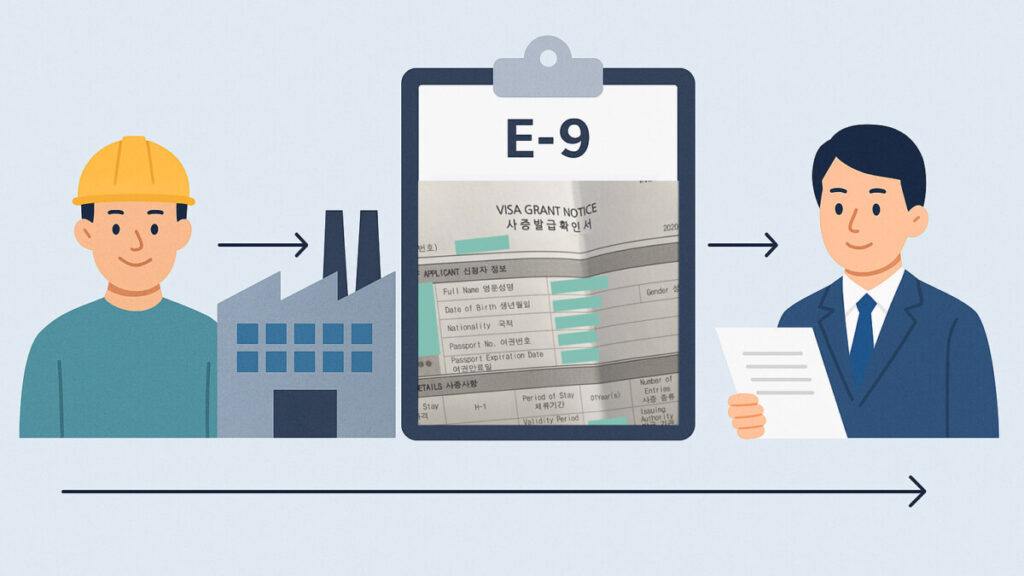
What Is the Korea E-9 Visa? Essential Information for Non-Professional Foreign Workers
Do you want to get a job in Korea? If you want to engage in economic activities in Korea even without special skills or education, you need to learn about the ‘E-9 visa.’ The E-9 visa is commonly called the ‘non-professional employment visa’ and is a system that invites foreign workers to fill Korea’s labor shortage.
It provides opportunities to work in fields requiring simple repetitive tasks or physical labor and plays an important role in Korea’s economy. However, many people feel overwhelmed due to lack of information about the E-9 visa or finding it complicated.
This article will explain everything about the E-9 visa easily and clearly. We’ll cover in detail why the E-9 visa is important, who can apply, what the application procedures are, and what the differences are with the frequently mentioned ‘seasonal work.’ Through this article, we’ll resolve your questions about the E-9 visa and help make your dream of employment in Korea a reality.
Definition and Purpose of E-9 Visa
The E-9 visa is classified as ‘Non-Professional Employment (E-9)’ status under the Republic of Korea Immigration Control Act. This is a visa that allows employment in specific fields such as production functions, service industries, and agriculture and fisheries in Korea without professional skills, knowledge, or education.
The main purposes of the E-9 visa are as follows:
Resolving Domestic Labor Shortage: When experiencing labor shortages in specific industries such as manufacturing, construction, agriculture and fisheries, and service industries, necessary foreign workers can be hired through the E-9 visa.
Protecting Foreign Workers’ Rights: Workers who entered with an E-9 visa can legally work according to employment contracts and receive protection under labor laws. This contributes to preventing illegal employment or human rights violations and creating a fair working environment.
Contributing to Economic Revitalization: Foreign workers increase Korea’s productivity and contribute to economic revitalization by positively impacting domestic consumption.
The E-9 visa is often operated through the Employment Permit System (EPS) agreement with specific countries. The Korean government manages E-9 visa issuance targeting industries with high labor demand and specific countries.
Characteristics of E-9 Visa
The E-9 visa has several important characteristics that distinguish it from other employment visas.
Non-Professional: As mentioned earlier, the E-9 visa applies to occupations that don’t require advanced professional skills or education. Therefore, professionals such as doctors, lawyers, and professors cannot enter with an E-9 visa.
Initial Stay of 4 Years and 10 Months: Foreign workers who entered with an E-9 visa can in principle stay and work in Korea for up to 4 years and 10 months. This period may vary depending on the number of workplace changes, etc.
Workplace Change Restrictions: E-9 visa holders are required in principle to continue working at the workplace where they were initially employed upon entry. However, workplace changes are possible within a certain number of times if there are reasons stipulated by law, such as business closure, business deterioration, or serious dissatisfaction with working conditions.
Designated Industries: E-9 visas are mainly allocated to specific occupations in manufacturing, construction, agriculture, forestry, and fisheries, and service industries (restaurants, accommodation, etc.). Not all industries can employ E-9 visa workers.
Employment Permit System (EPS) Based: Most E-9 visas are operated through the Employment Permit System (EPS). That is, if a Korean employer wishes to employ foreign workers, they must obtain employment permission through the Ministry of Justice and Ministry of Employment and Labor.
Understanding these characteristics is very important when preparing for an E-9 visa or seeking related information.
E-9 Visa Eligibility Requirements: Who Can Work in Korea?
To apply for an E-9 visa, you must meet several basic eligibility requirements. These requirements apply not only to the foreign workers themselves but also to Korean employers seeking to hire them.
Foreign Worker Eligibility Requirements
To work in Korea with an E-9 visa, you must meet the following eligibility requirements:
Nationality: The E-9 visa is only allowed for citizens of specific countries. The Korean government designates countries eligible for E-9 visa issuance based on labor demand and bilateral agreements. You can check the current list of countries eligible for E-9 visa issuance on the Human Resources Development Service of Korea (HRD Korea) website.
Age: Generally, there are age restrictions from 18 to 39 years old. However, this age range may be adjusted slightly depending on the industry or workplace characteristics.
Health Status: You must be in a health status that allows normal work activities in Korea. You must undergo health examinations at designated hospitals before or after entry, and must not have diseases harmful to public health such as infectious diseases.
Criminal Record: You must not have a criminal record that prohibits entry according to Korean law.
Skills and Education: Since the E-9 visa is a non-professional employment visa, it doesn’t require advanced skills or specific education. However, you may need to have basic work performance abilities required by the industry.
Korean Language Ability (Optional): Korean language test (TOPIK) scores are often not mandatory requirements for official E-9 visa applications. However, employers may require Korean language ability, or you may need to complete Korean language education for smooth communication after employment. Passing the EPS-TOPIK (Korean Language Test) is one of the important processes for employment.
No Disqualifying Reasons: You must not fall under other entry restriction reasons stipulated in Korean laws.
Korean Employer Eligibility Requirements
Korean employers wishing to hire foreign workers with E-9 visas must also meet the following requirements:
Eligible Industries for Foreign Labor Employment: Must belong to industries eligible for employment permits, such as manufacturing, construction, agriculture, forestry, fisheries, and some service industries.
Proof of Labor Shortage: Must prove that there are difficulties in hiring domestic workers at the workplace. (Example: When recruitment notices above minimum wage were posted but no one was hired)
No Disqualifying Reasons: Employers or executives of the workplace must not have violated laws such as hiring illegal residents or concealing industrial accidents.
Meeting Workplace Scale and Industry Standards: There are limits on the number of foreign workers allowed by industry, and there may be standards for workplace scale and productivity.
These eligibility requirements can be checked in more detail on the Human Resources Development Service of Korea (HRD Korea) or Ministry of Employment and Labor related websites.
E-9 Visa Application Process: The Process to Working in Korea
The process to working in Korea with an E-9 visa may seem somewhat complex. It can be largely divided into the foreign worker aspect and the Korean employer aspect, and proceeds based on the Employment Permit System (EPS).
Step 1: Take and Pass the Korean Language Test (EPS-TOPIK)
For most E-9 visa applicants, taking and passing the Korean Language Test (EPS-TOPIK) is essential.
Test Registration: Register for the EPS-TOPIK test conducted by the Human Resources Development Service of Korea (HRD Korea). Test schedules and locations are announced through the HRD Korea website.
Take Test: Take the written test (Korean language ability evaluation).
Pass Announcement: Those who achieve a certain score or higher are determined as passers. Passers gain basic qualifications for E-9 visa application.
Step 2: Ministry of Employment and Labor’s Foreign Labor Employment Permit Application (Employer)
Korean employers must obtain a ‘Foreign Worker Employment Permit’ from the Ministry of Employment and Labor to hire foreign workers.
Job Opening Application: Employers express their intention to hire foreign workers and apply for job openings through the HRD Korea website.
Manpower Supply Plan Confirmation: The Ministry of Employment and Labor examines the industry, scale, domestic worker hiring efforts, etc., of the workplace to review the necessity of introducing foreign labor.
Employment Permit Issuance: If requirements are met, the Ministry of Employment and Labor issues an employment permit for foreign workers to the employer. This permit is valid for a certain period, and foreign workers must be matched within this period.
Step 3: Matching Employer and Worker and Concluding Employment Contract
Once employment permission is issued, matching between employers and EPS-TOPIK passers takes place.
Manpower Dispatch: Employers receive recommendations for suitable workers from the employment-permitted labor pool through HRD Korea or are introduced to workers through dispatch agencies.
Interview and Hiring: Employers conduct interviews with recommended workers and make final hiring decisions.
Employment Contract Conclusion: Once hiring is confirmed, employers and workers prepare standard employment contracts. This contract specifies working conditions, wages, working hours, etc.
Step 4: Ministry of Justice’s E-9 Visa Issuance Application
Once an employment contract is concluded, workers apply for E-9 visa issuance in their home country or within Korea.
Visa Application Document Preparation: Workers submit necessary documents (passport, EPS-TOPIK pass certificate, employment contract, copy of employment permit, etc.) for E-9 visa issuance application to the Korean embassy/consulate in their home country or the Korea Immigration Service office in Korea.
Visa Review and Issuance: The Ministry of Justice reviews submitted documents and issues an E-9 visa if judged to have no disqualifying reasons.
Step 5: Entry to Korea and Employment
Foreign workers who received visas enter Korea and officially begin employment activities.
Entry: Enter Korea with the issued E-9 visa.
Employment Education: After entry, you may need to complete education designated by the Ministry of Justice (social integration program, etc.) for a certain period.
Start Working at Workplace: After completing education, start working at the workplace according to the employment contract.
This process may vary slightly depending on circumstances, and there are necessary documents and procedures for each step, so careful checking is important.
Seasonal Work vs. E-9 Visa: What’s the Difference?
Recently, as the ‘seasonal worker’ system has been actively operated to solve labor shortages in rural areas in Korea, there are many cases of confusion with the E-9 visa. While both systems have in common that they utilize foreign workers, there are clear differences in purpose, stay period, eligibility requirements, etc.
Seasonal Work System
The seasonal work system is mainly a system to secure labor intensively needed during farming seasons or periods of high catches.
Purpose: Resolving temporary labor shortages in rural areas.
Stay Period: Enter with a short-term stay visa (usually C-4, short-term employment) or short-term visit visa (B-1, B-2) and stay for up to 5 months (3 months additional extension possible, total 8 months). Since 2023, the Ministry of Justice has improved the system to limit seasonal workers’ stay period to a maximum of 5 months and allow reentry without limit on frequency.
Main Target: Mainly short-term jobs in agriculture and fisheries.
Application Procedure: Apply through local governments (city/county/district), and foreign workers are matched through Korean local governments that have agreements with local governments in their countries or through brokers.
Eligibility Requirements: Generally 19 years or older, healthy and sincere people. Unlike E-9 visas, separate Korean language tests are not essential, but basic communication skills may be necessary.
Characteristics:
- Very short stay period
- Mainly used intensively during farming seasons, fishing seasons, etc.
- Agreements between local governments play an important role
- Eligibility requirements are relatively relaxed compared to E-9 visas
E-9 Visa (Non-Professional Employment Visa)
As explained in detail earlier, the E-9 visa is a visa that allows long-term work in non-professional occupations.
Purpose: Resolving non-professional labor shortages in overall industries such as manufacturing, construction, agriculture and fisheries, and service industries.
Stay Period: Can stay up to 4 years and 10 months initially, with extension possible if certain conditions are met.
Main Target: Non-professional workers in various fields such as manufacturing, construction, agriculture, forestry, fisheries, and service industries.
Application Procedure: Employers receive employment permission through the Employment Permit System (EPS), and foreign workers are issued visas after passing the EPS-TOPIK test.
Eligibility Requirements: There are relatively clear requirements such as EPS-TOPIK pass, age, health, and criminal record.
Characteristics:
- Long-term stay and work possible
- Systematically managed through the employment permit system
- Restrictions on workplace changes
Summary Table:
| Category | Seasonal Work | E-9 Visa (Non-Professional Employment Visa) |
|---|---|---|
| Purpose | Resolving temporary labor shortages in rural areas | Resolving non-professional labor shortages in various industries |
| Stay Period | Maximum 5 months (8 months with extension) | Initial 4 years 10 months (extension possible) |
| Main Target | Labor for specific periods such as agriculture, fisheries | Non-professional positions in manufacturing, construction, agriculture, forestry, fisheries, services |
| Application Procedure | Local government agreements, brokers, etc. | Employment Permit System (EPS), EPS-TOPIK test |
| Eligibility Requirements | Relatively relaxed (age, health, etc.) | Clear requirements such as EPS-TOPIK pass, age, health, criminal record |
| Entry Route | Local governments, brokers | HRD Korea, dispatch agencies |
| Managing Entity | Local governments, Ministry of Justice | Ministry of Employment and Labor, Ministry of Justice |
You can understand that seasonal work is a system focused on working in Korea for a short period and returning, while the E-9 visa is a system focused on working long-term in Korea and engaging in economic activities.
Tips and Precautions for E-9 Visa Holders
Here are some practical tips and essential precautions for those starting or preparing for life in Korea with an E-9 visa.
Tips for Successful Life in Korea
Make Efforts to Learn Korean: Although the E-9 visa may not require Korean language tests in some cases, Korean language ability is very important for living and working in Korea. If basic communication is possible, it greatly helps not only with work adaptation but also understanding Korean culture and building relationships with locals. Actively utilize free Korean language education programs from HRD Korea or local communities.
Accurately Understand Employment Contract Contents: The employment contract concluded before or after entry is the most important document specifying your rights and obligations. Carefully check contract contents such as wages, working hours, holidays, provision of meals and lodging, and welfare benefits, and be sure to inquire with employers or related agencies about any parts you don’t understand.
Familiarize Yourself with Korean Labor Law: Foreign workers also receive protection under Korean labor laws such as the Labor Standards Act and Minimum Wage Act. If you receive unfair treatment or there are violations of law, don’t hesitate to seek help. You can receive consultation through the Ministry of Employment and Labor Customer Service Center (1350 without area code) or the Foreign Resident Support Center (1345 without area code).
Learn Workplace Change Procedures in Advance: If you inevitably need to change workplaces, you must comply with the period and procedures stipulated by law. If you leave or change workplaces arbitrarily, you may become an illegal resident, so be sure to consult with related agencies in advance.
Actively Communicate: Korean culture and work methods may be unfamiliar. If you have questions or difficulties, don’t worry alone but actively seek help from employers, colleagues, or related support agencies.
Precautions You Must Know
Prohibition of Illegal Stay: E-9 visa holders can legally stay and work only during permitted periods and at permitted workplaces. Staying beyond visa periods or working at unauthorized workplaces becomes illegal stay, which results in disadvantages such as forced deportation and future restrictions on entering Korea.
Prohibition of Unauthorized Employment Activities: Since the E-9 visa is a non-professional employment visa, it is strictly prohibited to engage in employment activities outside permitted occupations (e.g., entertainment businesses, professional occupations, etc.).
Foreigner Registration: You must register as a foreigner at the nearest Korea Immigration Service office within 90 days of entering Korea. The foreigner registration card serves as identification within Korea and is essential for various administrative processes.
Health Management: Health management in Korea is very important. Receive regular health checkups and receive treatment immediately if sick or injured. You may be eligible for industrial accident insurance coverage, so it’s good to familiarize yourself with related content.
Beware of Fraud: Be careful of fraud where people demand money under the pretext of arranging jobs in Korea or helping with visa issuance. Always check information through official channels such as HRD Korea and proceed with procedures.
The E-9 visa is a good opportunity to build an economic foundation while working sincerely in Korea. Please familiarize yourself with the tips and precautions provided above to create a legal and successful life in Korea.
INTERNAL_LINKS: (C-3 Visa)
EXTERNAL_LINKS:
- HRD Korea Official Website, Ministry of Employment and Labor: https://www.hrdkorea.or.kr/ENG
- Korea Immigration Service: https://www.immigration.go.kr/immigration_eng/index.do